Detailed guide

Quote Workflow

The quote workflow for converting approved estimate intent into a clear client-facing commitment with defensible totals, billing method, and acceptance state.

Quote Workflow is the external commitment checkpoint between estimating and invoicing. It should prove that what the client sees still matches approved scope and that downstream billing can be traced back to an explicit accepted commercial record.

Quick summary

  • Confirm quote identity, lifecycle state, and expiry timing before sending or accepting.
  • Cross-check quote totals and margin against the linked estimate before client communication.
  • Review billing method and milestone values to avoid invoice trigger surprises after acceptance.
  • Expand quote history before commercial handoff so downstream teams can trust the record sequence.
  • Use the estimate back-link whenever quote values appear stale or inconsistent.
  • Manage quote-specific client review access before asking a client to review or accept through the portal.

Put it into practice

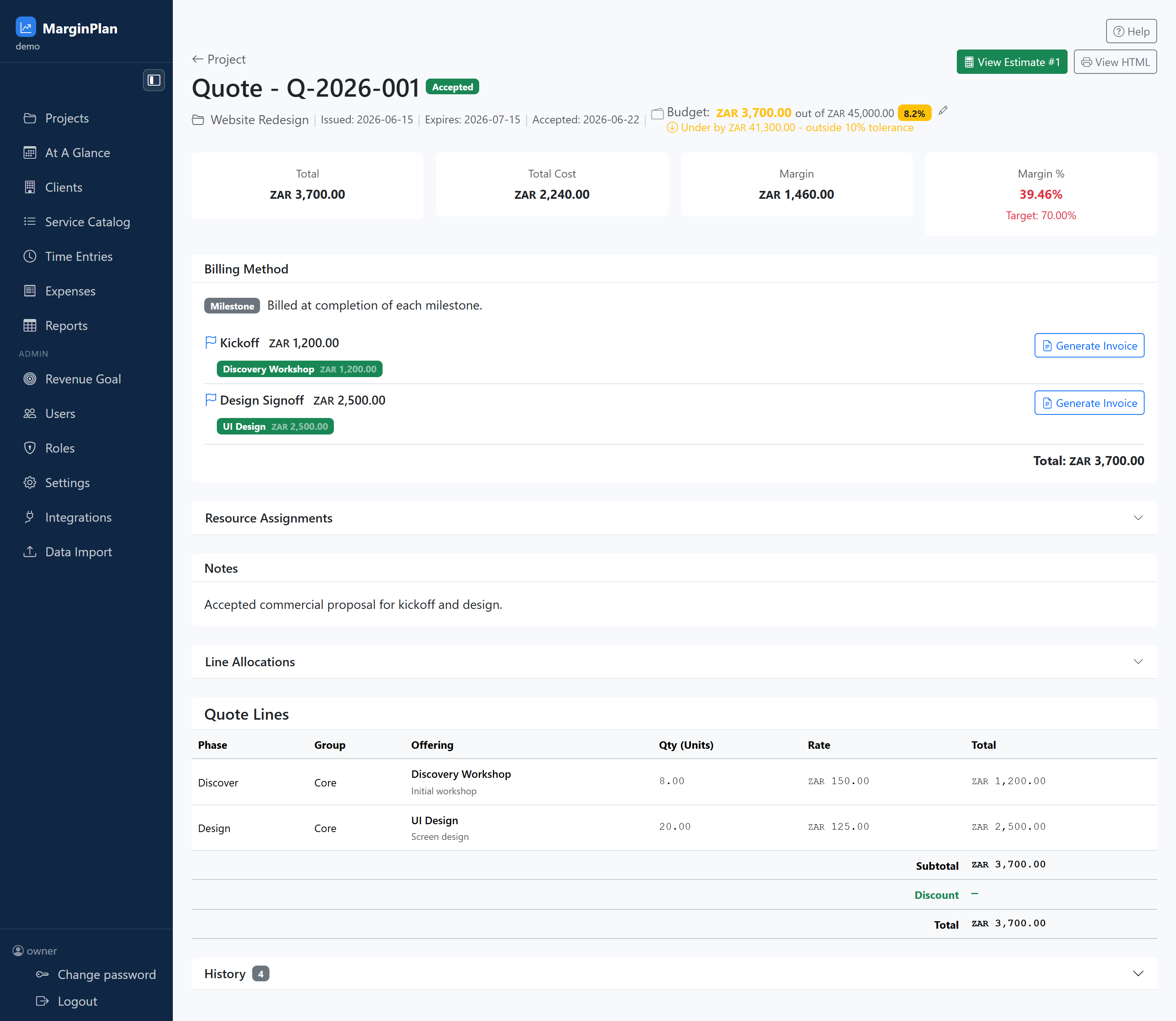
  1. Start by confirming quote identity and lifecycle state. Verify quote reference, status, and project name so you know whether this is a draft review, send-ready review, or post-acceptance control check.

    InteractionsProject Detail commercial area: open the target quote row, then verify the Quote header and status chip.
    Start by confirming quote identity and lifecycle state. Verify quote reference, status, and project name so you know whether this is a draft review, send-ready review, or post-acceptance control check.
    Open workflow: Project Detail
  2. Validate date and budget context before touching lines. Issued, expiry, accepted date, and tolerance messaging determine whether the quote is still commercially valid in its current form.

    InteractionsQuote header strip: review issued/expiry dates, accepted timestamp, and budget tolerance message.
    Validate date and budget context before touching lines. Issued, expiry, accepted date, and tolerance messaging determine whether the quote is still commercially valid in its current form.
  3. Use the linked estimate view when totals look suspicious. Confirm quote values still map to approved estimate assumptions before editing quote-level records.

    InteractionsQuote top actions: click View Estimate and compare structure, totals, and assumptions.
    Use the linked estimate view when totals look suspicious. Confirm quote values still map to approved estimate assumptions before editing quote-level records.
    Open workflow: Estimate Workflow
  4. Read Total, Total Cost, Margin, and Margin % as a quality gate before status transitions. If margin posture changed unexpectedly, resolve cause first rather than forcing status forward.

    InteractionsQuote page: review the four summary cards above Billing Method.
    Read Total, Total Cost, Margin, and Margin % as a quality gate before status transitions. If margin posture changed unexpectedly, resolve cause first rather than forcing status forward.
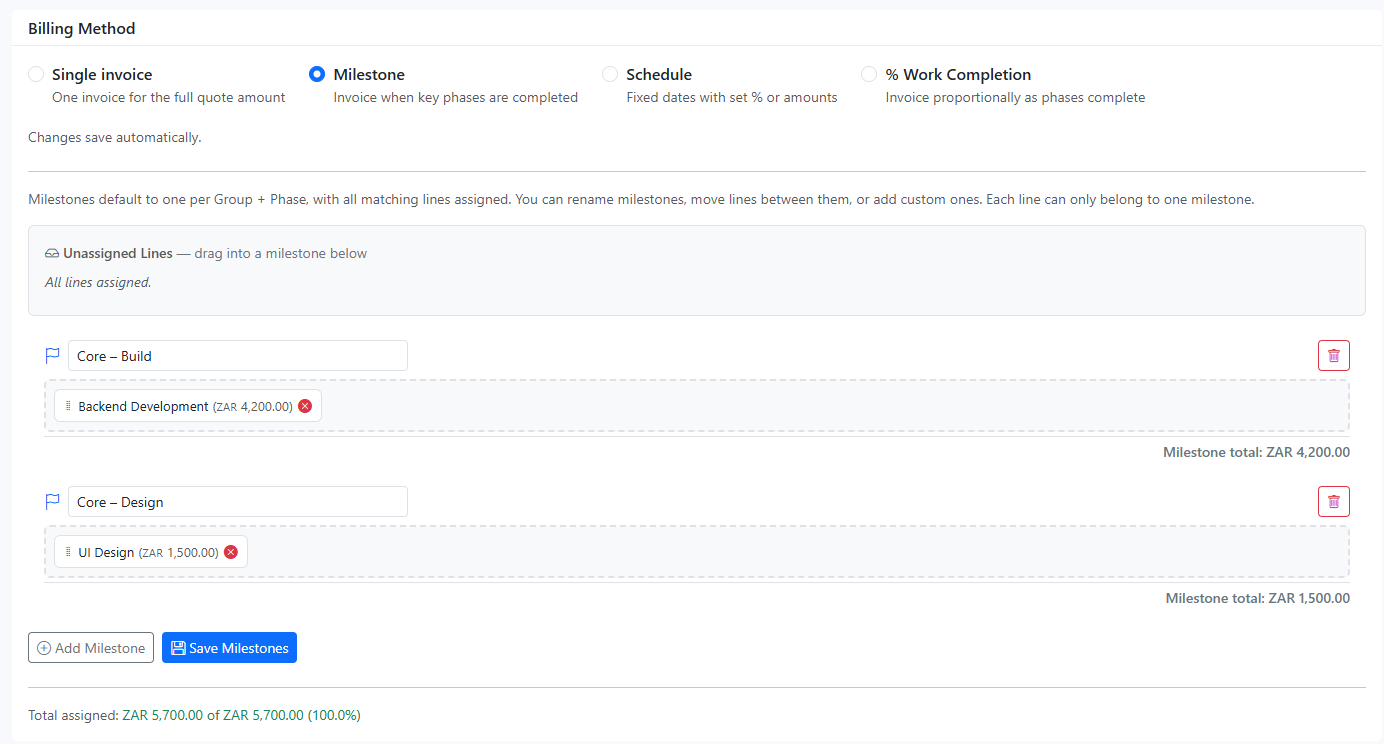
  5. Inspect Billing Method and milestone values so commercial promise and invoice mechanics remain aligned. Milestones should be clear, complete, and financially coherent.

    InteractionsQuote page: review Billing Method panel and each milestone amount block.
    Inspect Billing Method and milestone values so commercial promise and invoice mechanics remain aligned. Milestones should be clear, complete, and financially coherent.
  6. For Single invoice mode, confirm the radio option is Single invoice and verify the detail message states one invoice for the full quote amount. This mode is intended for one full invoice after quote acceptance.

    InteractionsBilling Method card: select Single invoice and review the Single invoice detail block under the radio options.
  7. For Milestone mode, verify milestones are grouped correctly (defaults are seeded per Group + Phase), then maintain assignments so each line belongs to only one milestone. Use Add Milestone and Save Milestones after any drag/drop or rename changes.

    InteractionsBilling Method card: select Milestone, review milestone cards and Unassigned Lines, then use Add Milestone and Save Milestones.
  8. For Schedule mode, define instalment rows with description, due date, and value type (% or amount). Save the table and confirm schedule totals and due-date intent before using per-item invoice generation.

    InteractionsBilling Method card: select Schedule, use Add Row, complete instalment fields, then click Save Schedule.
  9. For % Work Completion mode, invoice only completed, uninvoiced lines. Use the line checklist and Generate Invoice for Selected so billing follows delivery progress instead of invoicing the whole quote at once.

    InteractionsBilling Method card: select % Work Completion, choose pending line checkboxes, then click Generate Invoice for Selected.
  10. For Retainer (Repeated) mode, configure cadence settings first: Frequency (weekly/monthly/quarterly/yearly), Start Date, End Date, optional Default Invoice Day, and Next Invoice Date. After acceptance, use Generate Next Retainer Invoice per cycle.

    InteractionsBilling Method card: select Retainer (Repeated), save retainer settings, then use Generate Next Retainer Invoice in the recurring billing panel.
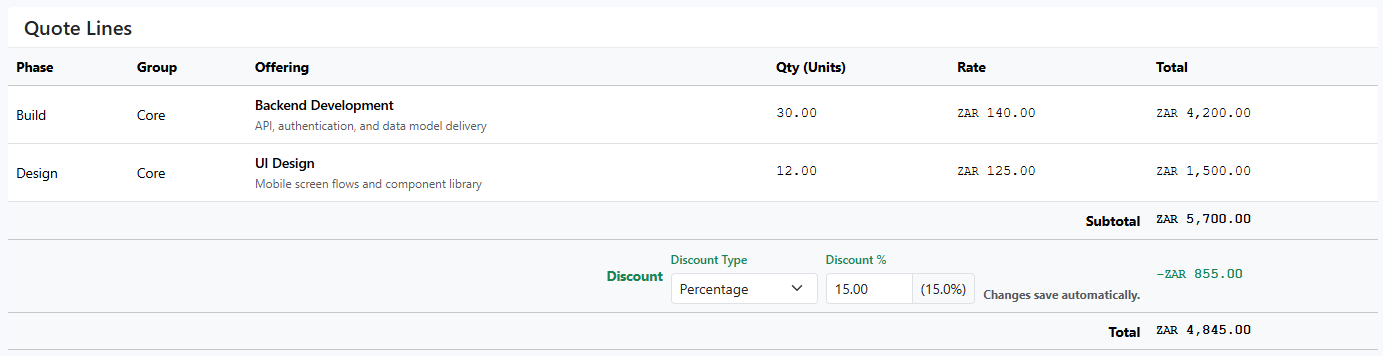
  11. Review Quote Lines in detail before send or acceptance: phase, offering, quantity, rate, discount state, and total must match the intended client commitment.

    InteractionsQuote Lines table: scan rows and subtotal/discount/total summary at the bottom of the table.
    Review Quote Lines in detail before send or acceptance: phase, offering, quantity, rate, discount state, and total must match the intended client commitment.
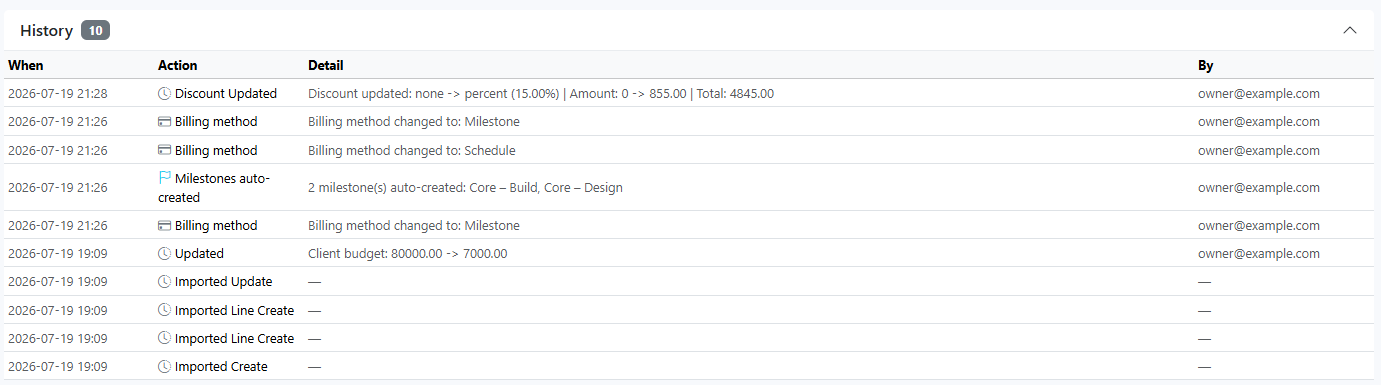
  12. Expand History and confirm event sequence integrity. The timeline should clearly show imported/created/updated actions in an order that supports audit and billing confidence.

    InteractionsBottom of quote page: expand the History accordion and verify timestamped action rows.
    Expand History and confirm event sequence integrity. The timeline should clearly show imported/created/updated actions in an order that supports audit and billing confidence.
  13. Only then continue to billing triggers. Use milestone Generate Invoice actions when quote acceptance, scope integrity, and billing terms are confirmed.

    InteractionsBilling Method panel: use Generate Invoice on the correct milestone and continue in invoice workflow.
    Only then continue to billing triggers. Use milestone Generate Invoice actions when quote acceptance, scope integrity, and billing terms are confirmed.
    Open workflow: Invoice Workflow
  14. Grant or verify quote sharing from Client Review Access before sending a client to the portal. Use Add To Allowed List for the target email and remove stale entries from Shared with.

    InteractionsQuote page: open Client Review Access, enter Client email, click Add To Allowed List, then verify the Shared with list.
    Open workflow: Client Portal

What to review

Quote header and lifecycle status

Confirms quote identity, reference, and status so the team knows whether they are drafting, sending, revising, or operating from an accepted commitment.

Project and date context strip

Shows linked project, issued/expiry dates, accepted timestamp, and budget posture so commercial actions are anchored to the current timeline and tolerance state.

Estimate and HTML handoff actions

View Estimate verifies upstream pricing assumptions and View HTML shows what the client-facing document renders like before or after send.

See guide: Estimate Workflow

Commercial summary cards

Total, Total Cost, Margin, and Margin % provide the quote-level quality gate before status transitions or invoice generation.

Billing Method section

Defines how value is invoiced and exposes five concrete modes: Single invoice, Milestone, Schedule, Retainer (Repeated), and % Work Completion. Each mode changes which controls appear and which invoice actions are valid.

Billing Method mode details

Single invoice: one full-amount invoice for an accepted quote. Milestone: line items are grouped into milestones and invoiced per milestone. Schedule: instalment rows define label, due date, and percent/amount. Retainer (Repeated): recurring cadence with frequency/date window and Generate Next Retainer Invoice. % Work Completion: select uninvoiced lines and generate invoice for selected lines.

Milestone invoice trigger actions

Generate Invoice controls turn accepted quote checkpoints into billable records; use only when status, scope, and trigger conditions are valid.

See guide: Invoice Workflow

Quote lines and totals table

The lines table is the evidence of what the client agreed to; check offering, quantity, rate, discounts, and total integrity before any status change.

Resource Assignments and Line Allocations

These sections expose how quoted work maps to delivery structure. Use them to detect mismatches before execution or billing divergence starts.

Quote notes

Notes capture commercial rationale and client context that explain why the quote was accepted in its current form.

History panel

Tracks quote events over time and is the audit trail to confirm lifecycle changes happened in the correct order.

Client Review Access panel

The Client Review Access card lets you add emails with Add To Allowed List, shows Shared with entries, and removes access with the x action.

See guide: Client Portal
Guardrails

  • A quote should always be explainable from approved estimate lineage plus explicit commercial adjustments.
  • Status transitions should follow business reality; do not mark accepted when unresolved pricing or scope conflicts still exist.
  • Quote totals, milestone amounts, and billing method logic should reconcile with downstream invoice expectations before trigger actions are used.
  • Billing method controls should match intended behavior: one full invoice (Single invoice), grouped deliverables (Milestone), dated instalments (Schedule), selected completed lines (% Work Completion), or recurring cycles (Retainer (Repeated)).
  • Expiry and accepted date context should be reviewed before reusing an older quote as the basis for current commitment.
  • History should show a coherent event trail so finance and delivery can audit what changed and when.
  • Quote send/accept and structural commercial edits should be restricted to roles accountable for client commitment and margin ownership.
  • Delivery roles may need read visibility to verify scope integrity even when they cannot change quote lifecycle state.
  • Invoice-generation controls from quote milestones should remain permission-gated to prevent premature billing events.

If it starts drifting

  • If quote totals look stale, open the linked estimate first and confirm whether quote regeneration or controlled update is required.
  • If margin drops unexpectedly, check line-level rate/quantity changes and discount state before blaming billing logic.
  • If Generate Invoice appears too early, verify quote acceptance status and billing trigger readiness before proceeding.
  • If milestone invoicing looks wrong, check for unassigned lines or line items accidentally moved to the wrong milestone card.
  • If schedule invoices are mismatched, confirm each schedule row value type (percent vs amount) and due date before generating item invoices.
  • If repeated billing fails, verify retainer frequency and next invoice date are configured and still within the start/end date window.
  • If work-completion invoicing is blocked, confirm at least one uninvoiced line is selected before submitting.
  • If clients dispute line intent, compare quote lines and notes against estimate assumptions and explicit exclusions.
  • If history appears incomplete, confirm that updates were made through supported workflow actions rather than out-of-band edits.